
Tunisian national team arrives in Monterrey as Khedira passport photo fuels debate
he Carthage Eagles have reached Mexico ahead of their World Cup opener against Sweden, while a photo of Rani Khedira holding a German passport drew criticism and defence online.
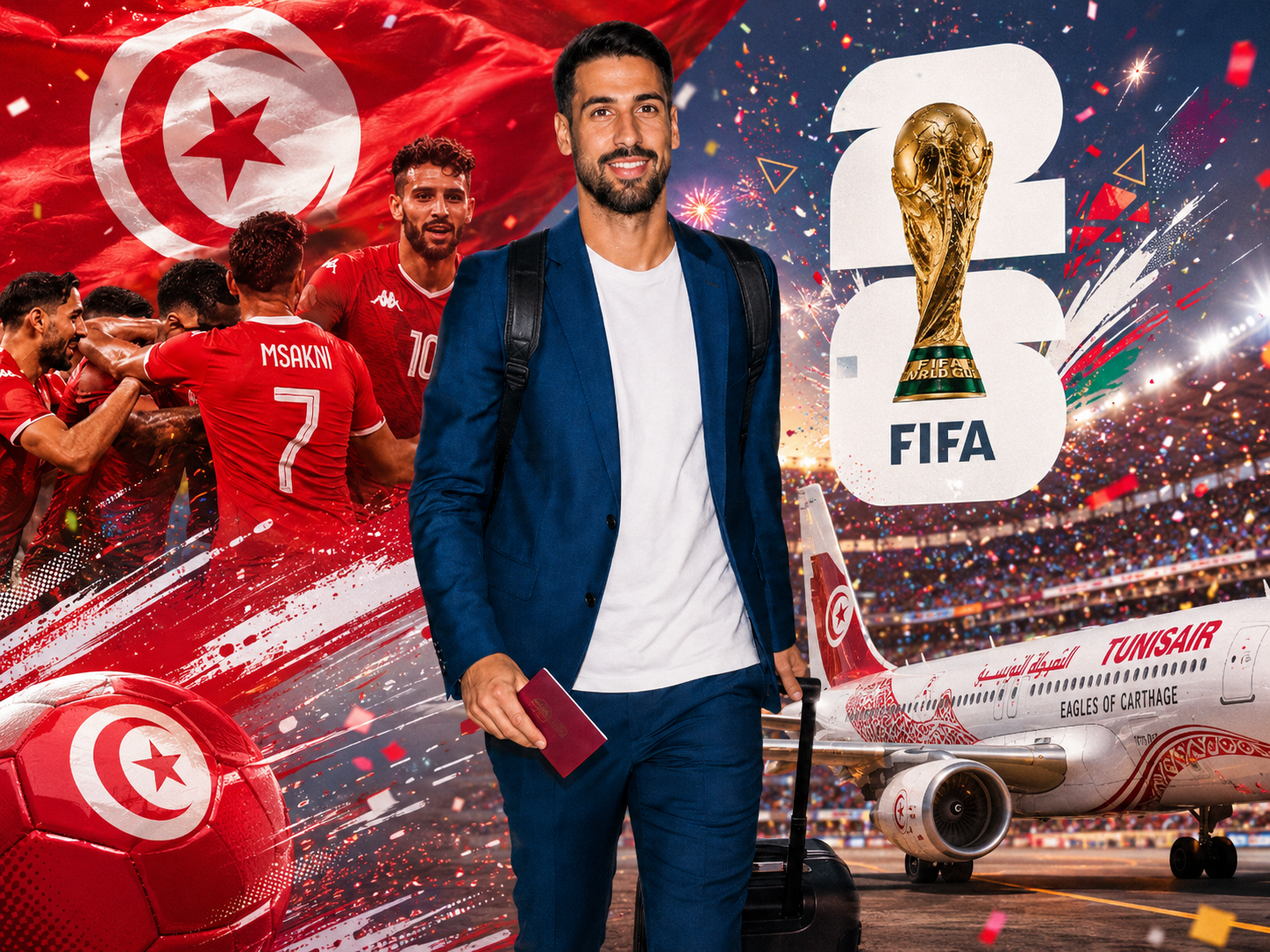
Tunisia’s national football team has arrived in Monterrey as preparations continue for the 2026 FIFA World Cup.
The Carthage Eagles will open their Group F campaign against Sweden at Monterrey Stadium on 15 June.
They will then face Japan at the same venue on 21 June before travelling to Kansas City to play the Netherlands on 26 June.
The squad’s arrival follows two final preparation matches in Europe.
Tunisia lost 1-0 to Austria in Vienna on 1 June, then suffered a 5-0 defeat to Belgium in Brussels on 6 June.
The Belgium match turned sharply after Hannibal Gharbi was sent off for a second yellow card around the hour mark, leaving Tunisia to finish the game with 10 men.
Attention around the squad has also focused on Union Berlin midfielder Rani Khedira, whose selection has become one of the most debated calls of Sabri Lamouchi’s World Cup list.
The latest controversy began after the Tunisian Football Federation published photos of the squad’s arrival in Mexico.
One image showed Khedira holding a German passport while completing arrival procedures with the Tunisian delegation.
The image was later removed from the federation’s Facebook album, according to Tunisian media reports.
The photo drew criticism from some Tunisian supporters online, who questioned the symbolism of a player representing Tunisia at the World Cup appearing with another country’s passport.
Other users defended Khedira, noting that he was born and raised in Germany, legally holds German nationality and may have used the passport for ordinary travel or administrative reasons.
The passport photo revived an older debate over Khedira’s relationship with the Tunisian national team.
Khedira, 32, was born in Stuttgart to a Tunisian father and German mother. He represented Germany at youth level but never played for Germany’s senior national team.
Tunisia had previously approached him before he eventually changed sporting nationality this year.
In 2015, Khedira declined a Tunisian approach, saying he felt at home with Germany’s football federation and identified with the German system.
He also turned down Tunisia before the 2018 World Cup in Russia, telling Kicker at the time that he was born and raised in Germany, spoke only German and did not feel he could fully help the team at short notice.
Those earlier refusals are now central to the criticism directed at him by some supporters and commentators.
The argument is that Khedira declined Tunisia when he still had prospects in German football, then accepted the call at 32 with a World Cup place available.
His defenders argue that players with dual nationality are entitled to make career decisions, that eligibility rules allow the switch, and that Tunisia should use any player who can strengthen the squad.
FIFA approved Khedira’s change of sporting nationality in March, making him immediately eligible for Tunisia.
Khedira is the younger brother of Sami Khedira, who won the 2014 World Cup with Germany.
Lamouchi was asked about Khedira earlier this year and said he would not beg any player to represent Tunisia, while insisting that any call up must add value to the national team.
Khedira’s inclusion comes alongside other changes in Lamouchi’s squad.
Khalil Ayari and Rayan Elloumi were selected, while former captain Ferjani Sassi and defender Yassine Meriah were left out.
The omissions of Mohamed Ali Ben Romdhane and Seifeddine Jaziri have also drawn criticism from supporters and sports media.
Ben Romdhane scored the stoppage time goal against Equatorial Guinea that sealed Tunisia’s qualification for the World Cup and finished as the team’s top scorer in the qualifying campaign.
Tunisia is preparing for its seventh World Cup appearance and its third in a row after Russia 2018 and Qatar 2022..