
UNHCR in turmoil as protesters demand it leave Libya, exposing a hardening migration debate
Claims about UNHCR refugee documents have triggered protest calls in Tripoli and statements from Libya’s rival authorities, turning migrant settlement into a new political flashpoint.
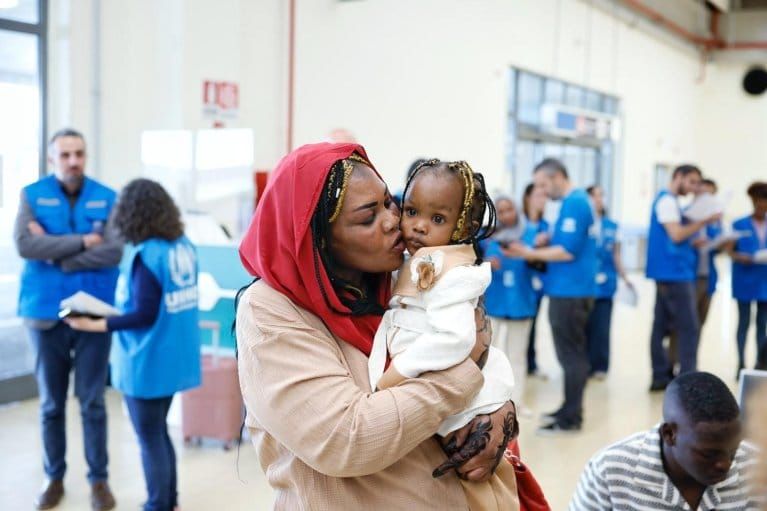
Hundreds of protesters gathered outside the headquarters of the UN refugee agency in Tripoli on Thursday, demanding that UNHCR shut its offices and leave Libya.
The protest was the largest in a week of demonstrations organised under the slogan “No to Settlement, No to Naturalisation, Libya for Libyans.” What began as a local dispute in one Tripoli district has become a national argument over migration, sovereignty and the fear that Libya is being turned into a permanent holding ground for people Europe does not want to receive.
UNHCR says the accusation is false. It says it does not set Libya’s migration policy, does not grant residence and does not run any programme to settle migrants in the country.
The call for the agency to leave has not formally come from either of Libya’s rival governments. It has come from protesters and local social councils. But both administrations have moved quickly to harden their language around the same theme: Libya rejects settlement, rejects naturalisation and will not accept migration arrangements imposed from outside.
The spark came from Al Sarraj, a district in western Tripoli where UNHCR keeps an office and where queues of foreign nationals are a familiar sight.
In late May, the local social council said it had received reports that pharmacies and shops were being contacted about providing medicine and services to people holding refugee cards. It told local businesses to refuse, warning that such arrangements could encourage unlawful residence and place pressure on the area.
Then the videos began to move online. Queues outside the UNHCR office. Registration cards held up to the camera. Claims that the documents were not humanitarian records but proof of a hidden plan.
Within days, a local complaint about services had been recast as evidence of settlement. By 30 May, the council was calling for a mass protest and demanding that UNHCR leave.
UNHCR issued its denial on 2 June. Its work in Libya, it said, is limited to humanitarian assistance, registration and protection, carried out in coordination with the authorities.
A refugee registration card does not give its holder Libyan residency. It does not determine who can enter the country, stay in it or be deported from it. It records that a person is a refugee or asylum seeker for the purpose of assistance and protection.
By then, the clarification was chasing a campaign that had already found its language.
Tripoli’s foreign ministry tried to contain the issue without appearing soft on migration. On 1 June, it rejected any settlement of irregular migrants in Libya, while warning against rumours, incitement and actions that could damage diplomatic missions or Libya’s international relations. The message was careful: no to settlement, but also no to attacks on the UN.
The House of Representatives took a harder line. In Statement 2 of 2026, it called on state institutions to confront any step that could be interpreted as preparing to settle foreigners, described sovereignty and identity as red lines and cited Law No. 24 of 2023 on combating the settlement of foreigners.
The eastern government of Osama Hamad followed with its own warning, rejecting any migration or resettlement arrangement made without Libyan approval and ordering UNHCR and the International Organization for Migration to comply with Libyan law.
In some districts, including Dahra, local councils have reportedly told landlords to evict migrant tenants.
Libya’s rival administrations agree on almost nothing about who governs the country. On migration, they have found one of the few issues where political firmness costs little. The campaign has collected official cover from both sides of a divided state.
One government voice tried to separate the rumour from the policy question.
Tripoli’s foreign minister, Taher Al Baour, told Libya Al Ahrar that settlement had never been discussed and that Libya would not become a third country for hosting migrants. UNHCR cards, he said, are issued only to seven nationalities: Somalis, Eritreans, Sudanese, South Sudanese, Yemenis, Syrians and Palestinians.
The point of the card, Al Baour said, is to help refugees move on to a third country, not to keep them in Libya. He said Libyan authorities, working with IOM and UNHCR, had returned more than 30,000 migrants, including around 9,000 through UNHCR. The build up of people in Libya, he argued, was linked to low acceptance rates in the countries meant to receive them. Libya needs foreign labour to rebuild, he added, but wants that labour organised legally.
The UN mission in Libya warned on 1 June that misinformation and inflammatory rhetoric were spreading online, including content targeting specific groups, and that such narratives risked fuelling discrimination and violence.
The protests have drawn strength from a fear that extends beyond UNHCR: that Libya is being turned into a holding ground for Europe’s migration problem.
That fear has a policy context. The EU’s Pact on Migration and Asylum begins to apply this month. In February 2026, Brussels widened its “safe third country” rule, allowing an EU member state to send an asylum seeker to a country outside the bloc even without a personal connection to it. In March, negotiations opened on “return hubs” beyond Europe’s borders.
Libya already carries part of that burden. People are intercepted in the central Mediterranean, returned to Libyan territory and held there. The campaign against UNHCR misidentifies the agency’s role, but it is unfolding against a real shift in European migration policy.
The language also has a regional precedent.
In February 2023, Tunisian President Kais Saied told his national security council that “hordes” of sub Saharan migrants were part of a criminal plan to change the country’s demographic composition and erase its Arab and Islamic identity. He said unnamed parties had been paid since 2011 to settle them. He offered no evidence.
The speech was followed by attacks, evictions and dismissals targeting Black migrants and Black Tunisians. Saied rejected accusations of racism while standing by his claims. Tunisia later repatriated more than 10,000 migrants.
The Libyan campaign echoes much of that thesis: settlement, demographic change, foreign plots and eviction orders. The difference is that Libya has two governments, competing security forces and a much wider spread of armed actors.
The numbers complicate the image on the placards.
Libya hosts one of the largest migrant populations in the region. IOM counted 939,638 migrants in late 2025 and 936,134 in the first two months of 2026, the highest figures it has recorded. Those numbers are widely treated as undercounts, partly because the east is harder to survey.
Most of those people are not refugees waiting to be settled. According to IOM, 84 percent come from North and West Africa. The largest groups are Sudanese at 36 percent, Nigerien at 20 percent, Egyptian at 19 percent and Chadian at 9 percent.
Most are in Libya to work, in construction, agriculture, services and private homes. Their presence is politically contested, but their labour is part of the economy.
The refugee card at the centre of the protests is held by a minority. Of more than 460,000 Sudanese who have reached Libya since the war in Sudan began in April 2023, fewer than 90,000 are registered with UNHCR. Total registration across all nationalities stood near 198,000 late last year.
The campaign compresses different people into one feared category: a Sudanese refugee, a Nigerien labourer, an Egyptian worker, a Chadian migrant and a person intercepted at sea.
Humanitarian work has been cast as a security threat before. In April 2025, Libya’s Internal Security Agency closed some international NGO premises, accusing them of activities touching state security and of trying to settle migrants. In September 2025, raids in Sabratha detained hundreds, while protests in Misrata targeted a migrant market.
The people most exposed are not the officials issuing statements. They are refugees and migrants with little protection, now facing a campaign that has moved from online accusation to street mobilisation.
Human Rights Watch has documented abuse of migrants and refugees in Libya, including arbitrary detention, forced labour, extortion and sexual violence. UN bodies have called for an end to the return of intercepted boats to Libya until safeguards are in place. Libyan authorities deny that abuse is systematic.
This week, before the main protest in Tripoli, monitors reported new arrests of Sudanese families in several cities.