
What happened to Donald Trump’s Board of Peace?
Launched in Davos as the body that would help govern and rebuild Gaza after the ceasefire, the Board of Peace is now caught between empty funding channels, stalled disarmament talks and renewed Israeli military expansion.
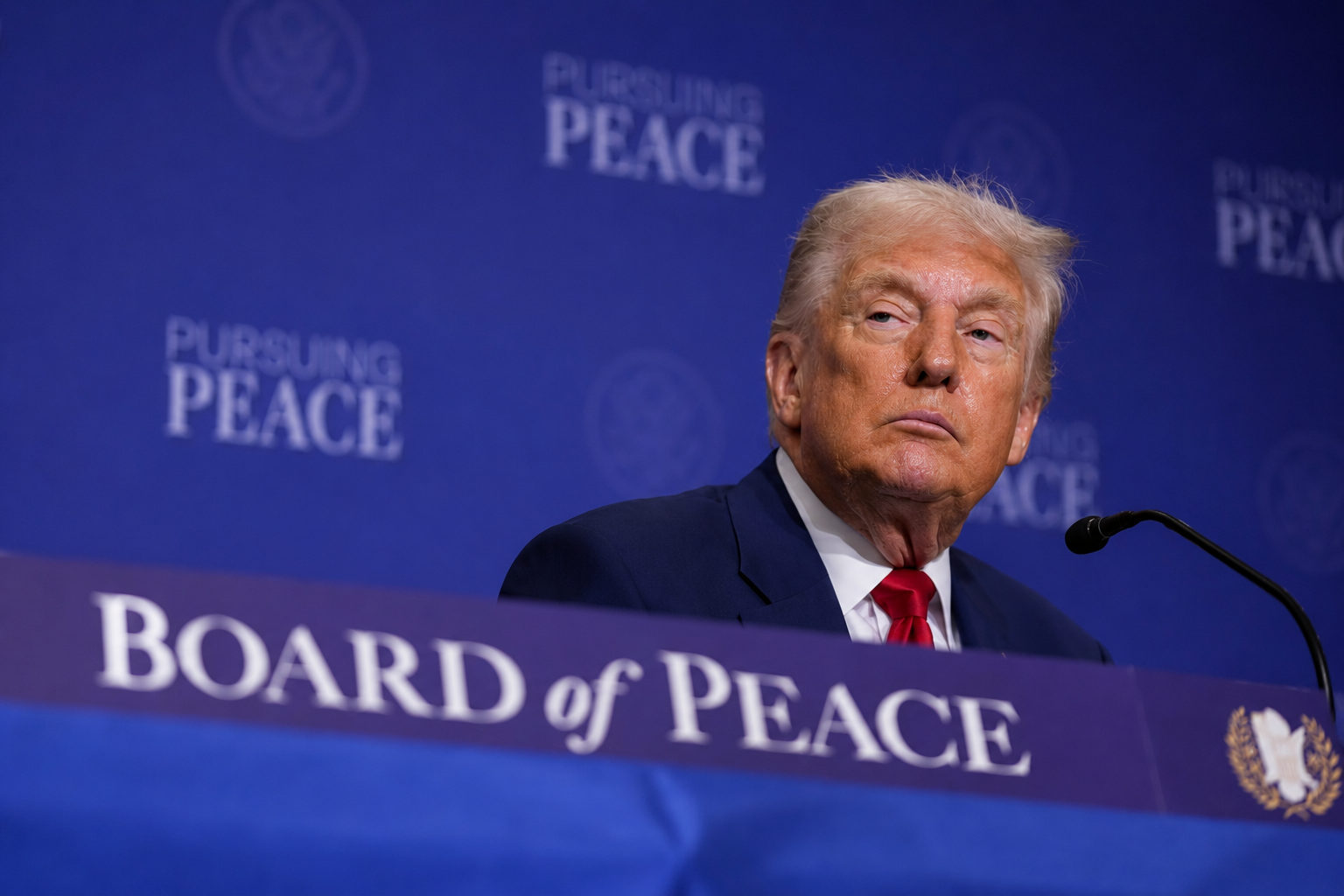
When Donald Trump launched the Board of Peace in Davos in January, it was presented as the institution that would turn a ceasefire in Gaza into something more durable.
There was the familiar theatre of Trump diplomacy: the grand signing ceremony, the language of history, the promise of reconstruction, and the suggestion that Gaza could be transformed from a devastated enclave into a modern Mediterranean hub. Jared Kushner, Trump’s son in law and one of the central figures behind the plan, spoke of free market principles and a future in which Palestinians would be given “dignity” and the chance to thrive.
Trump called the Board of Peace one of the most consequential bodies ever created. Its backers said it would mobilise resources, enforce accountability and guide the next phases of demilitarisation, governance reform and rebuilding.
Five months later, the board looks less like a new international order than an institution waiting for the conditions that were supposed to justify its existence.
The idea emerged from Trump’s 20 point plan to end the Gaza war. The first phase of that plan brought a ceasefire between Israel and Hamas in October 2025, the release of hostages, and a framework for humanitarian access. The second phase was always more difficult. It required Hamas to give up control of Gaza, Israeli forces to withdraw in stages, and a new Palestinian technocratic committee to manage day to day administration under international supervision.
The Board of Peace sits above that structure. Trump chairs it. A smaller executive board includes figures such as former British prime minister Tony Blair, US envoy Steve Witkoff and Kushner. A Gaza focused board and a Palestinian technocratic body, the National Committee for the Administration of Gaza, were meant to translate the political plan into government, services and reconstruction on the ground.
That has barely begun.
The Palestinian committee remains largely outside Gaza. Its members were supposed to prepare the administration of public services, municipal affairs and basic governance. Instead, according to diplomats and reporting from Cairo, they have spent much of their time meeting foreign officials while waiting for access and authority. In Gaza, power remains fragmented between Hamas, Israeli military control, local networks and humanitarian organisations trying to operate in impossible conditions.
The funding picture is just as stark. AFP reported last month that the Board of Peace’s official reconstruction fund, administered through the World Bank, had received no donor money, despite pledges worth billions of dollars. The Board has reportedly received some donations through a separate JPMorgan account, but the central fund created for Gaza’s reconstruction remains empty.
The explanation is simple and damaging. Donors are reluctant to finance reconstruction while the political and security framework is unresolved. Gaza cannot be rebuilt at scale while Israeli strikes continue, while most of the population remains displaced, while Hamas has not disarmed, and while no credible authority is actually governing the territory.
The ceasefire has become the central weakness in the whole design. It stopped the largest phase of the war, but it did not settle the key questions left for later. Hamas has resisted disarmament. Israel has continued military operations. Each side accuses the other of violating the truce. Reuters reported on Monday that Israeli strikes killed six Palestinians in Gaza, including a child, as mediators in Cairo tried to salvage the next phase of the US brokered agreement.
Netanyahu has now ordered Israeli forces to expand control over Gaza to 70% of the enclave. Under the original ceasefire arrangements, Israeli troops were meant to remain behind a “Yellow Line” covering about 53% of Gaza. Reuters reported that Israel already controls more than 60%, with new markers and barriers pushing deeper into areas close to displacement camps and populated zones.
That leaves the Board of Peace in a vicious circle. It needs peace to attract money. It needs money to show it can deliver. It needs a Palestinian administration to give reconstruction legitimacy. That administration needs access to Gaza and a minimum of security. None of those conditions are in place.
The regional context has also moved against it. Arab governments that were expected to provide political cover and financial support are absorbed by a wider Middle East crisis, including the war involving Iran and Israel. Gulf states may still see value in influencing Gaza’s reconstruction, but they have little incentive to pour money into a mechanism that could collapse into renewed war, or be seen by Palestinians as an externally imposed authority with limited sovereignty.
There was always a deeper problem in the Board’s design. It was announced with the language of reconstruction, but its authority was highly centralised around Trump personally. Membership was invitation based. Permanent participation required a reported $1 billion commitment. Critics in Europe and at the United Nations warned that it could sideline existing multilateral institutions, while supporters argued that the UN system had failed to move quickly enough.
For Gaza’s civilians, that debate now feels remote. The practical question is whether any institution can bring food, shelter, policing, services and reconstruction to a territory where two million people are still living with the consequences of war.
The Board of Peace was built as a vehicle for the day after. Gaza has not reached the day after. Until it does, Trump’s most ambitious Middle East institution will remain caught between ceremony and reality: announced as a mechanism for peace, but still waiting for peace to administer.