Abidjan Redefines Its Military Partnerships With Beijing, Paris and Washington
Chinese weapons, a lighter French footprint and closer American ties are reshaping Ivory Coast’s place in West Africa’s security order
Ivory Coast is emerging as one of the most important security partners in coastal West Africa, at a moment when the region’s old military arrangements are being revised and the instability of the Sahel is pressing steadily south.
The shift is visible in three directions at once. China is supplying heavier military equipment. France has handed over its long standing base at Port Bouët while preserving a smaller advisory role. The United States is deepening military cooperation through exercises, senior defence visits and special operations training.
Taken together, these moves point to a country intent on widening its security relationships without surrendering control over them. Abidjan is building a more diversified defence posture, one shaped by the threat from its northern borders, the decline of France’s traditional military dominance in parts of West Africa, and Washington’s search for reliable partners after setbacks in the Sahel.
The Ivorian government has strong reasons to move carefully but decisively. Its northern frontier borders Mali and Burkina Faso, both deeply affected by jihadist violence and state fragility. Côte d’Ivoire has avoided the severe deterioration seen in parts of Benin and Togo, but the pressure remains real. Attacks in previous years, cross border trafficking, refugee movements and recruitment networks have kept the north high on the security agenda.
The response has involved both domestic measures and external partnerships. The state has reinforced its military presence in the north, invested in border security and worked to improve the capacity of its armed forces. At the same time, it has sought equipment, training and political support from several foreign partners.
China has become increasingly visible in that equation. Ivorian military displays in 2024 and 2025 showed Chinese built armoured vehicles, including VN22B wheeled fire support vehicles produced by Norinco. The acquisition gives the army greater mobility and firepower, particularly in areas where forces may need to move quickly across difficult terrain or reinforce exposed positions.
The purchase is part of a broader trend. Beijing’s security role in Africa is no longer limited to military diplomacy or peacekeeping rhetoric. Chinese defence companies are increasingly present in African procurement markets, offering equipment that is often more accessible, faster to acquire and less politically encumbered than Western alternatives.
For Ivory Coast, the appeal is practical. Chinese hardware helps fill capability gaps without forcing Abidjan into exclusive dependence on any one partner. It also reflects a wider African preference for diversified procurement, where governments combine Chinese equipment, Western training, Turkish drones, European funding and national command structures.
France remains central, though in a different form. In February 2025, Paris handed over its military base at Port Bouët to Ivorian authorities. The site had long symbolised France’s military presence in the country and housed the 43rd Marine Infantry Battalion. Its transfer marked a significant moment in the reconfiguration of French forces in West Africa.
The handover was presented by both governments as an orderly transition rather than a rupture. A smaller French presence is expected to remain focused on training, advice and cooperation. That distinction matters. In Mali, Burkina Faso and Niger, France’s military exit followed political confrontation and a broader rejection of French influence. In Ivory Coast, the relationship is being reduced, reframed and made less visible, while preserving channels that both sides still consider useful.
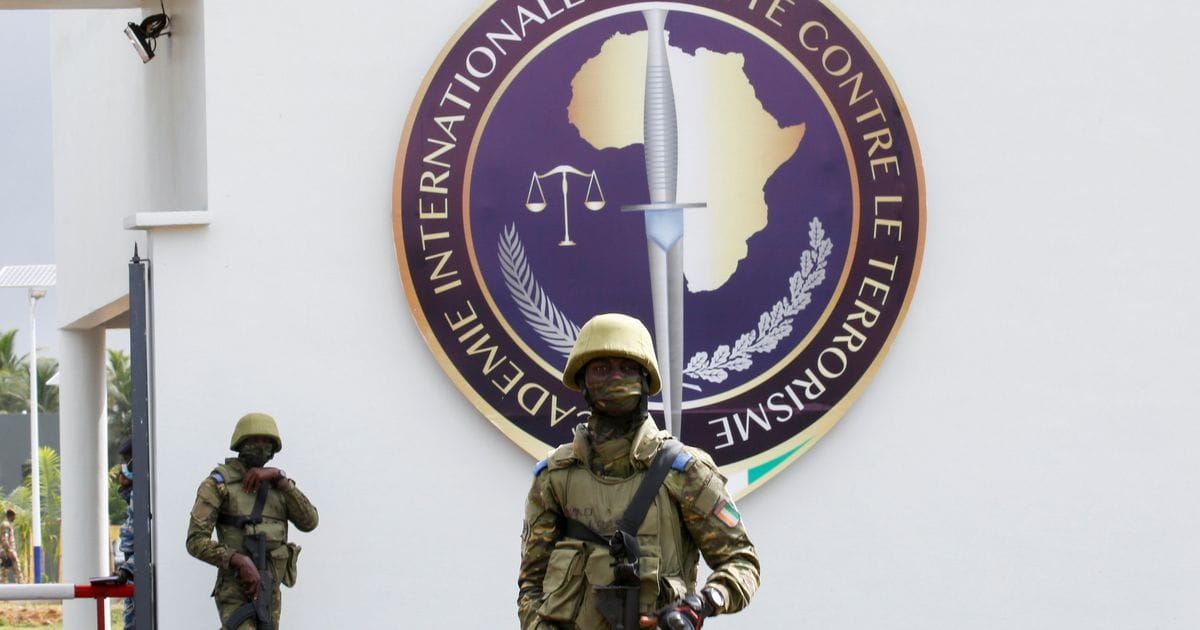
The International Academy for the Fight Against Terrorism in Jacqueville is one example of that continuing role. Established with French support, the academy trains security personnel, magistrates and officials from the region. It allows France and its partners to remain involved in counter terrorism cooperation through an institutional platform that is less politically sensitive than a large permanent base.
The United States is also moving closer to Abidjan. Côte d’Ivoire hosted Flintlock 2025, the largest annual United States special operations exercise in Africa, bringing together hundreds of personnel from more than 30 countries. Washington has also intensified senior level defence engagement with both Côte d’Ivoire and Benin as it seeks to strengthen partnerships along the Gulf of Guinea.
The American interest is strategic. The loss of access in Niger weakened Washington’s position in the central Sahel. Coastal West Africa now carries greater importance for counter terrorism planning, maritime security, intelligence cooperation and regional military engagement. Ivory Coast offers relative stability, a strategic Atlantic location, and a government willing to cooperate without embracing the confrontational posture seen elsewhere in the region.
For Abidjan, each partner offers something different. China provides equipment. France offers institutional familiarity, training networks and long established defence ties. The United States brings special operations expertise, intelligence relationships, multinational exercises and global military weight.
This layered approach gives Ivory Coast room for manoeuvre. It also creates obligations. A military supplied, trained and advised by multiple partners must still operate as a coherent national force. Different vehicles, communications systems, maintenance chains, doctrines and training cultures can strengthen capacity if managed well. They can also complicate logistics and planning if acquisitions are not tied to a clear force structure.
The larger issue is political. Ivory Coast’s growing importance will attract expectations from all sides. Beijing will view defence sales as part of a wider relationship with a stable West African economy. Paris will seek to preserve influence through a lighter and less exposed footprint. Washington will see Abidjan as a potential anchor in a region where its options have narrowed.
The Ivorian government appears aware of the opportunity. It is converting geopolitical demand into military and diplomatic value. The country is positioning itself as a stable coastal state at a time when stability itself has become a strategic asset.
The danger is that external interest can become a substitute for national doctrine. The jihadist threat facing coastal West Africa cannot be met by armoured vehicles and foreign exercises alone. It requires intelligence, border governance, trusted local administration, economic opportunity and credible state presence in communities where armed groups may seek influence.
Ivory Coast’s relative success so far has depended on more than military posture. It has also involved prevention, local engagement and efforts to avoid the deep rupture between state and frontier communities seen in parts of the Sahel. That balance will become harder to maintain if insecurity deepens across the border or if armed groups adapt their strategy toward recruitment, smuggling and low visibility infiltration.
Abidjan’s emerging security model is therefore both ambitious and delicate. It reflects the new reality of West African defence politics: fewer exclusive alliances, more transactional partnerships, more competition among external powers, and greater insistence by African governments on choosing from several sources of support.
Ivory Coast has not broken with France. It has not handed its security future to China. It has not become an American platform. It is building a broader set of military relationships at a time when the region rewards governments able to balance partners without losing direction.
That balance will define the next phase of Ivorian defence policy. If managed well, it could strengthen the country’s armed forces and reinforce its role as a stabilising actor in coastal West Africa. If managed poorly, it could leave Abidjan with overlapping partnerships, rising expectations and no clear strategic centre.
For now, the direction is clear. Ivory Coast is turning foreign interest into leverage. The test will be whether it can turn that leverage into lasting security capacity.